Fahrenheit 451
Fahrenheit 451 is a science fiction drama film directed by François Truffaut in 1966. It was a semi adaptation from a novel which has the same name written by Ray Bradbury.* I should say that I didn’t read the book so there will not be any comparison between the two.

If I need to present a brief introduction to the topic of the movie without giving too many spoilers, I would say that the movie is very unusual, it is an alternate reality of our world but has similarities in very obvious ways. The main character of the movie (Montag) is a firefighter but not as you think: They burn books with his colleagues and if someone keeps books in their home, they get punished. He does his job without questioning anything until he read a book secretly and fascinated by it.

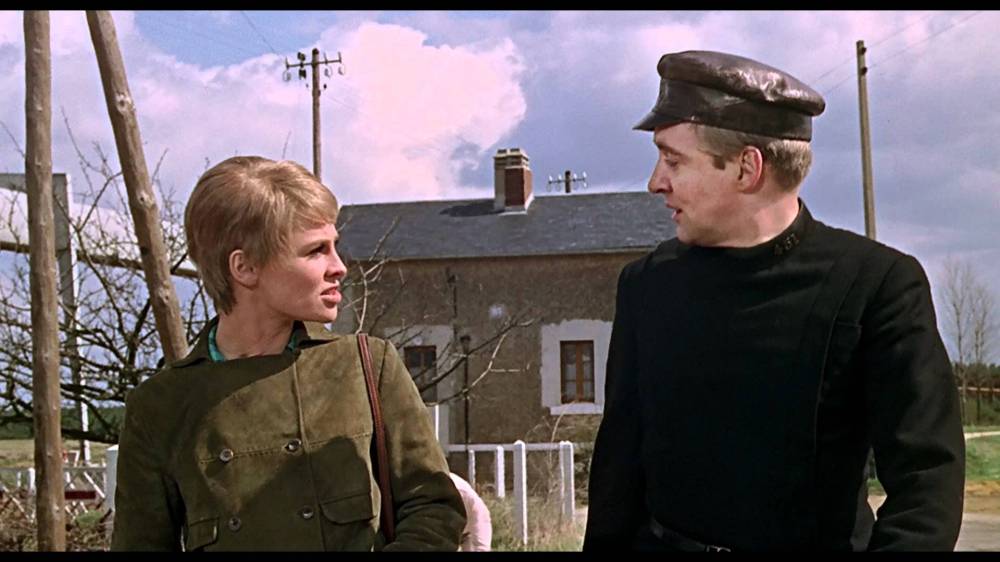
In one scene, when Montag arrived at his house, he found his wife as unconscious. After he carries her to bed, he tries to call the hospital (00:28:43). In this scene, the actor is so fussy. He closes his eyes while trying to remember the address of them, wait for a second and then answers. I think in this scene, the acting of the actor is very intense. Actually, in general, actor’s acting is quite successful. His nonverbal expressions are explanatory and coherent with his verbal expressions. I believe that the acting skills of the actress who played his wife were also remarkable (Julie Christie). She played in two different roles in the movie: one of them was the wife of Montag and one of them was Clarisse who helped and joined Montag in his claim. She just used different hair styles on these characters but I couldn’t understand that they are the same person until I checked the cast. The way she gives life to the characters were so fascinating that she made us believe that these two are different persons (or is this just me? 🙂 )
Throughout history, people used some type of stimulants. Some people used them for relaxing or fitting in a group. Some of them used for just relieving from boredom. Amphetamine was used against depression as a medicine. Nonmedical use of amphetamines was quite popular in the UK in the 1960s. There was no need for a prescription to have it. People almost from each group were using it. Even bored housewives were using it for energy boosting because they were feeling low. Inattentive usage of amphetamine increased too much and banned in 1964. **
In the movie Montag’s wife uses stimulants. One of the employees from hospital indicates that almost 50 people get sick because of these pills. In the film, for not remembering sad things or feeling sad, people try to get away from books. Those people do not experience their sadness truly. As a result of suppressing all feelings, people experience depression deeply and try to resolve this by stimulant usage. They prefer to focus on themselves and daily life. Also, television provides hope for ordinary people; they use television for avoiding from real life and their problems. I think the film tried to show essentially if people avoid from their real feelings instead of confronting with them, they lost their real self and as a result, their life become meaningless. They would not know what they are doing and why (after treatment of her, Linda thinks that she slept well last night and because of that she does not remember anything). Being upset, feeling bad senses are parts of our self-construction. Without them, we cannot be as ‘true we’. Also, the film tries to tell why people choose not to think and used drugs. The film basically demonstrates authoritative regime and media as responsible ones for answering these questions. We can see from scenes which Montag goes against authority and burn the TV which placed in his house.

According to Sigmund Freud’s psychoanalytic theory of personality, three elements were included in personality: id, ego, and superego. The id is driven by the pleasure principle. The id is the instinctual and primitive unit of personality. It consists of the sexual instincts (libido), and aggressive instinct (death). ***
The superego is a different part of the personality which includes internalized moral standards and ideals of people. It is our sense for deciding what is right and wrong. The superego ensures grounds for making judgments. ****
Throughout the history media used to impress people. Impressing people’s instincts easier rather than impressing their super ego. Because impressing super ego requires more time and money, media almost always focus people’s id. By focusing people’s id, media substantially prevent thinking and judgment. Actually, mainstream media and authoritative regimens support each other because both want the same thing: prevent thinking and make people obey. Today our mainstream media also serves to the same purpose.

In the movie, people touch themselves constantly, I think this is a sign from director which tells that media focuses ids of people and because of that they act like that (without their ego).
The books are banned by the government in the movie. Books serve against what media serves, enhancing thinking and judgment. Now besides books, the internet also serves as enhancing judgments and thinking by the availability of communication with other people and availability of getting information. That’s why some internet sites are banned by our government. And also that’s why mainstream media full of rape and death reports, series which focusing libido such as ‘Aşk-ı Memnu’ or ‘Muhtesem Yuzyıl’.
In this review of ‘Fahrenheit 451’, I mainly focused on what kind of reasons lead people to use stimulants, media’s effect on people and acting styles of main characters.
Serenity Thinker
References
*http://en.wikipedia.org/wiki/Fahrenheit_451_(1966_film)
**http://www.drugscope.org.uk/resources/drugsearch/drugsearchpages/amphetamines
***http://www.simplypsychology.org/psyche.html
**** http://psychology.about.com/od/theoriesofpersonality/a/personalityelem.htm


